Ceiling leak repair
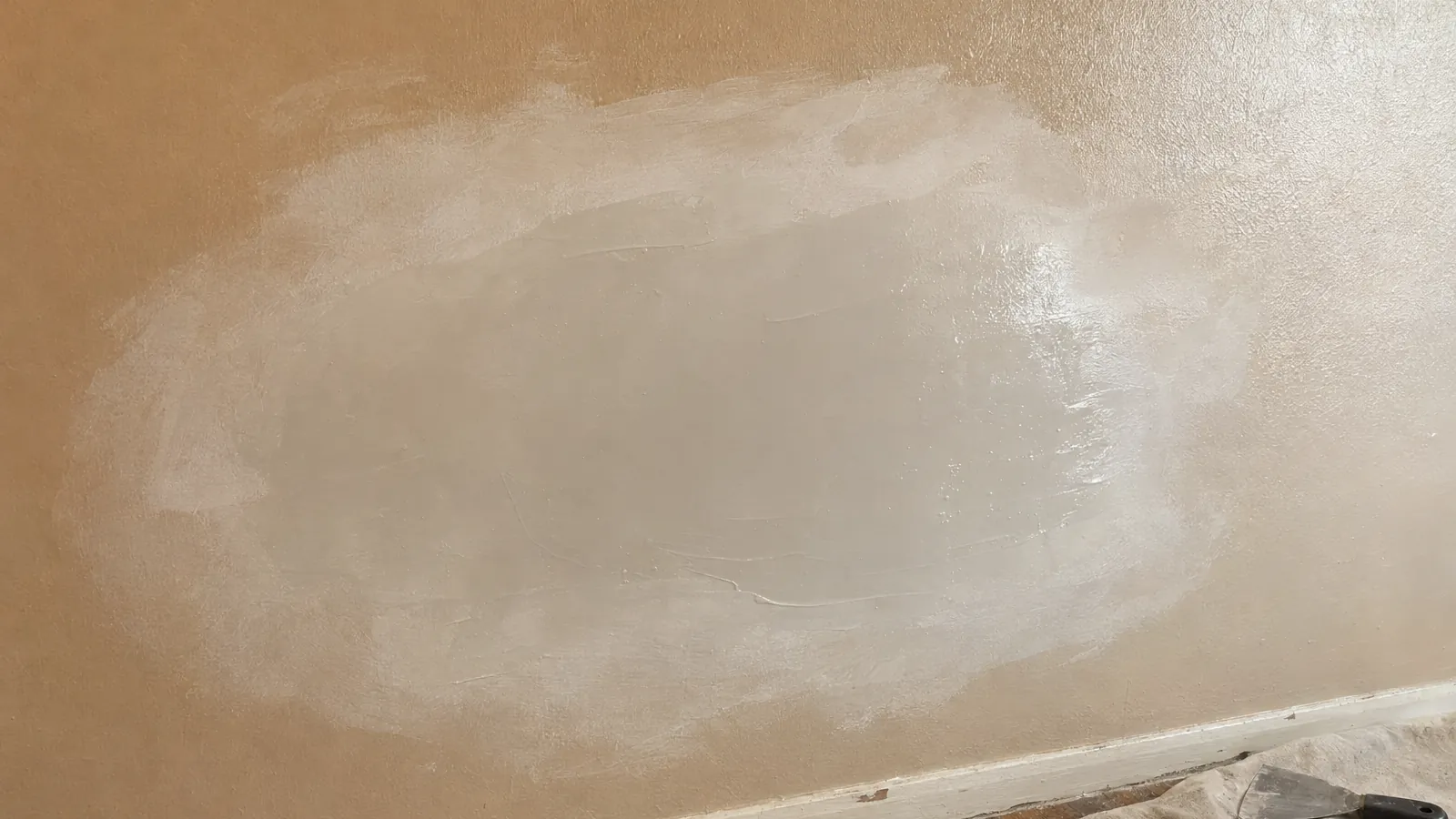
Ice-dam and roof-leak ceilings: wet board replaced, the outline sealed under stain-blocking primer, texture redone.
Ice-dam ceiling marks, popped nails, seam cracks, wet basement walls and move-out holes, rebuilt and given a matching texture so the patch blends with the rest of the wall or ceiling.
Call 7 days, 7am–9pm
Afterward, the contractor who would take on the work gets in touch to ask about size and surface and give a figure.
Richmond Heights is a Cuyahoga County city roughly 15 miles east of downtown Cleveland, by the Encyclopedia of Cleveland History's measure. That source lists 891 residents for 1950 and 5,068 for 1960, and links the jump to new gas and water mains laid in 1953. Population at the 2020 census: 10,801.
The housing stock still carries that boom. Census Bureau estimates covering 2020 to 2024 put the halfway point of construction at 1967: half of current homes were built before it, half after. Of 5,542 homes standing now, 3,912 were built in the fifties, sixties or seventies. Gypsum wallboard nailed to wood studs was standard practice then, and board of that vintage wears in a familiar way: nail heads lifting under the paint, joint tape loosening overhead, fine cracks leaving door corners at an angle.
Not every address is a ranch house. Wikipedia mentions ranch-style houses across the city and calls the Scottish Highlands, off Highland Road, its largest residential area; it also puts several big apartment complexes in the Loganberry section on Chardon Road. Census tables show 1,396 homes in buildings with 50 or more units, and renters occupy roughly one home in three.
| Built | Homes | Relative size | Share |
|---|---|---|---|
| 1939 or earlier | 46 | 1% | |
| 1940s | 318 | 6% | |
| 1950s | 1,303 | 24% | |
| 1960s | 1,606 | 29% | |
| 1970s | 1,003 | 18% | |
| 1980s | 207 | 4% | |
| 1990s | 431 | 8% | |
| 2000s | 278 | 5% | |
| 2010s | 309 | 6% | |
| 2020 or later | 41 | 1% |
Every group below links to a page laying out cause, method and the warning signs to look for later. Sheetrock repair that sits outside the four, like one gouge or a crushed outside corner, gets priced through the same steps.
Ice-dam and roof-leak ceilings: wet board replaced, the outline sealed under stain-blocking primer, texture redone.
Lifted nail heads reset with screws, and cracks bridged with paper or mesh tape rather than smeared full of paste.
Lower walls soaked by groundwater or a failed supply line, removed above the damp zone and rebuilt once the studs dry out.
Anchor craters, doorknob punctures and dented corners between leases, finished through primer.
Wikipedia's Cleveland climate article gives the lake-effect season as the middle of November until Lake Erie ices over, normally late in January or early in February. The snow is heaviest on the east side, where the ground climbs into the Heights and the Snow Belt starts, and the eastern suburbs collect more precipitation than the lakefront does. Inside a house here, that pattern shows up three ways.
Cause: warm attic air melts the bottom of the roof snow, and the runoff freezes again over the unheated overhang. Result: an ice ridge that pools later meltwater behind it, under the shingle tabs and down into the ceiling near exterior walls. Watch for: a brown line or blotch a foot or two in from the outer wall, typically appearing on a mild day after the storm.
Cause: long heating months pull moisture out of indoor air and out of the wood framing, which shrinks a fraction. Result: hairline cracks at door corners and along overhead joints that widen in winter and narrow by summer. Remedy: tape across the crack, because a crack that moves outlasts plain filler.
Cause: melting snow and spring rain saturate the soil together. Result: seepage through foundation walls that climbs the bottom of finished basement walls by wicking. Watch for: a tide mark, puffed-up baseboard, and a damp, musty odor behind paneling.
Drying time for each layer is why a mid-sized patch usually stretches across two or more days. The arrangement behind all this is set out under how we work.
Ceiling board hangs face-down beneath the attic and catches roof leaks and bathroom overflows before anything else does. Five ceiling problems are typical in houses of this age.
Water drags dissolved residue toward the rim of the soaked zone and leaves it there as it evaporates, which is why the outline is darker than the middle. Latex paint rewets that residue and the outline returns. Remedy: stain-blocking primer over the entire mark, then the ceiling painted from wall to wall to keep the sheen even.
Soaked gypsum turns soft and heavy. Kill the breaker serving each ceiling light or fan near the sag first. After that, nobody stands beneath it, and a pail sits under the lowest point. Sagged board is removed and replaced; pushing it back up does not restore it.
A gap along the line between ceiling and an inside wall that widens in the cold months and shrinks in summer usually points to trusses arching upward as the attic dries. Extra tape tends to tear again. Usual remedies are clips that allow the ceiling board to move free of the wall, or a crown molding that hides the movement.
Sprayed acoustic texture in houses built before the 1980s may contain asbestos. A lab test of a chip comes ahead of any scraping, patching or sanding, and the result sets the approach.
Daylight raking across a ceiling picks out ridged or bubbled tape. Bubbled tape is sliced away and bedded fresh, and the joint is skimmed broad enough to flatten the hump.
Leak marks and ice-dam damage get a fuller treatment on the ceiling leak repair page.
Drywall patching sorts into three bands. The band determines the method, the coat count, the width of texture blending and how much of the wall ends up repainted.
Up to roughly coin width. Filler, a light sand and spot primer; one or two skim passes is normal, and the texture blend stays tiny.
Edges are squared up and a backer goes behind, then a cover patch and three coats, each reaching well past the hole. Drying sets the schedule.
Fresh board fastened into the studs or joists, every joint taped, texture blended over a broad area. Repainting the full wall or ceiling is common at this size.
This site carries no price list, since two holes of identical size can price very differently. Five factors drive a figure: the count of separate spots, overhead versus wall height, the amount of texture blending, any cause such as a leak or loose fastener that comes first, and paint or no paint.
A paragraph on each city sits on the communities served page.
Lower walls and finished basements get their own page on basement water damage.
Sanded joint compound becomes a talc-fine powder that rides air currents from room to room. A careful setup contains it four ways.
When the price arrives, ask the contractor which of these are included and what should leave the room first.
Phone, a text with photos, or the form beside this all work. One photo and two sentences give enough to begin.
Call 7 days, 7am–9pm
Afterward, the contractor who would take on your wall gets in touch to settle measurements, finish and cost.
Afterward, the contractor who would take on the work reads this note and calls about size, surface and cost.